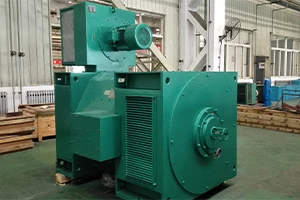
High-voltage slip-ring (wound-rotor) motors are widely used in industrial fan, pump, mining and cement systems, with liquid-resistance soft-starters serving as the mainstream startup solution for heavy-load smooth commissioning. Many end users confuse the functions of standard soft-start devices and professional speed-governing equipment, wondering whether a conventional liquid-resistance soft-starter can realize continuous motor speed regulation.
In fact, standard liquid-resistance soft-starters are only designed for short-term startup duty. Rated for 2 to 3 start cycles per day, their electrolyte tanks, electrodes and heat dissipation structures are only suitable for instantaneous slip heat generation during motor acceleration. After startup, the bypass contactor fully shorts the rotor loop, and the liquid resistor stops working completely. This type of equipment cannot support long-term series resistance operation for speed adjustment.
The rotor series liquid resistance speed control principle only achieves speed reduction below the rated speed, with no overspeed capability.

Taking the YRQ400-8 -150KW 6000V-737rpm rated speed motor as an example, operating stably at 737rpm brings low slip loss and minor heat generation. However, long-term operation at 420rpm forms a high slip ratio, producing massive slip power loss. Running a standard soft-starter under this condition will cause electrolyte boiling, electrode overheating and deformation, and even equipment breakdown and liquid leakage.
To achieve stable 420–737rpm stepless speed regulation, a dedicated liquid-resistance speed-governing cabinet is mandatory. Upgraded from standard starters, it adopts enlarged heat-dissipation tanks, thickened anti-corrosion electrodes and optional forced water cooling. Equipped with a PLC closed-loop control system and 4-20mA external signal access, it supports real-time speed tracking and stable speed locking.
It is worth noting that rotor liquid resistance speed regulation is a heat-consuming control mode with relatively low efficiency. For long-term heavy-load low-speed working conditions, a high-voltage variable frequency drive on the stator side is the more efficient and reliable optimal solution.